
Sound as a diagnostic tool for coral reefs' state and functioning
For the first time, passive acoustics enables standardised and continuous monitoring of coral reefs.
We will work together to choose the relevant sites and go all the way to put together customized coral reef protection measures.
Our custom scientific reports provide critical metrics about coral reefs' state and functioning and can be visualised on our dedicated website.
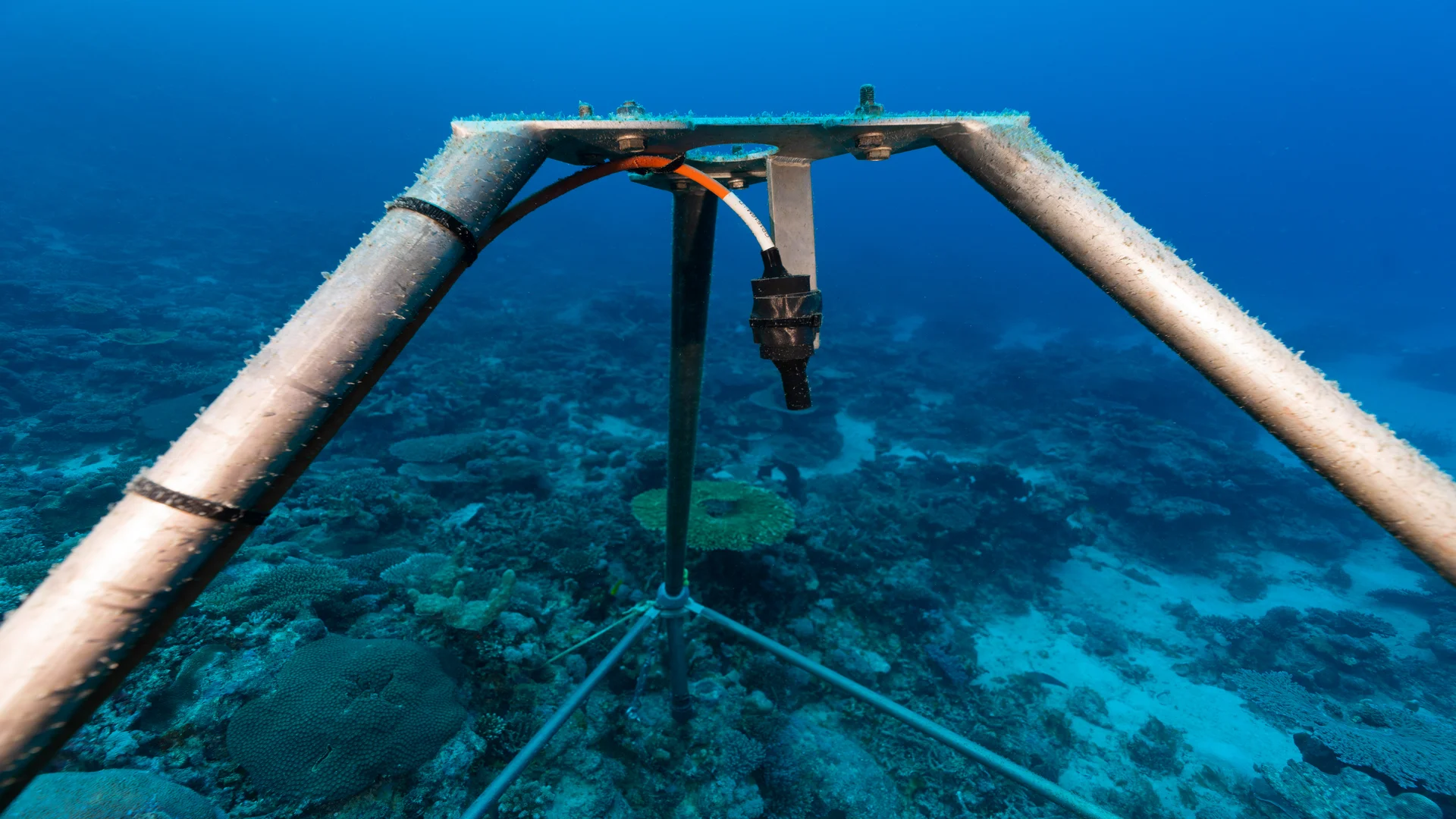
What is Ecoacoustics?
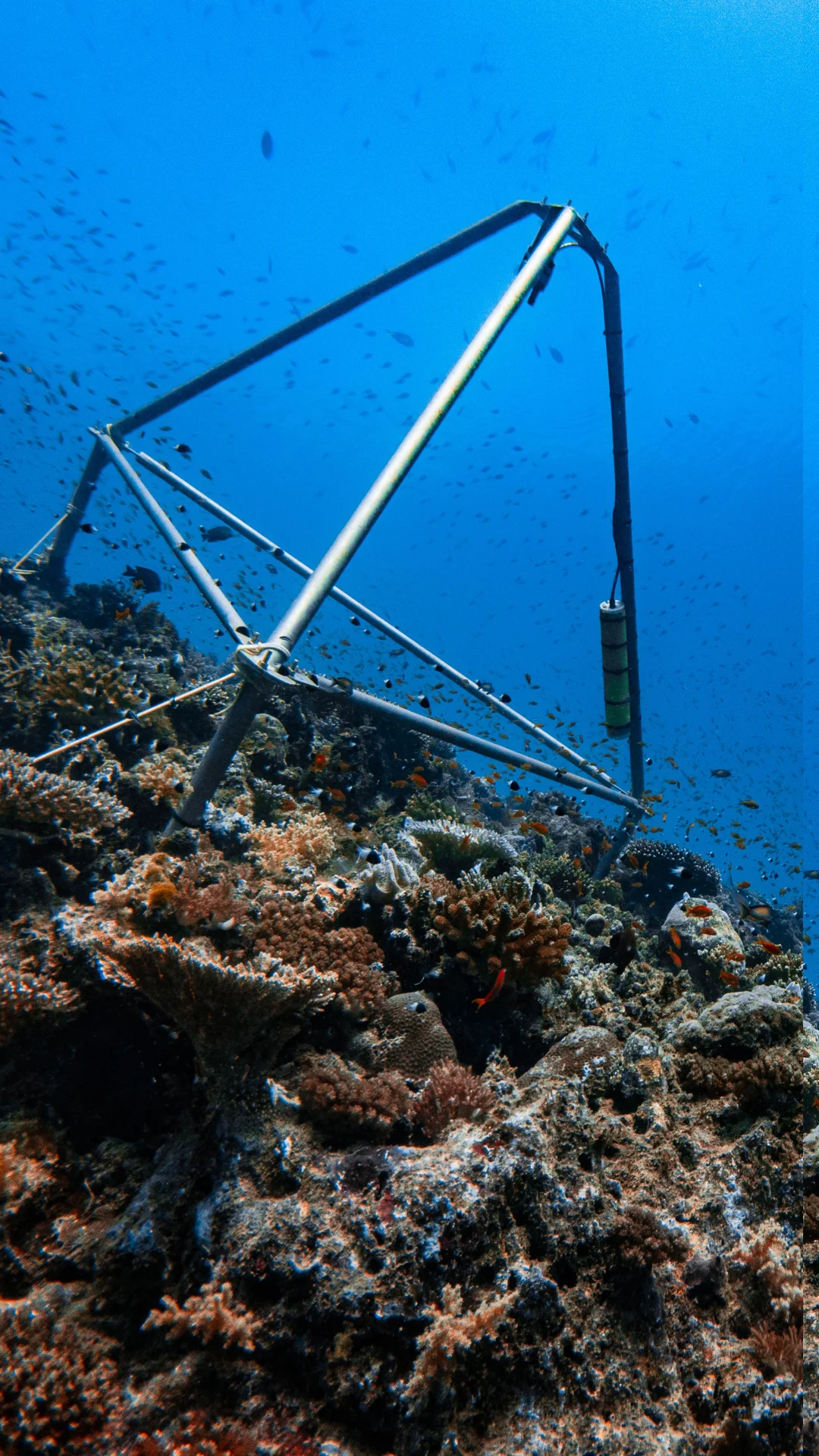
Ecoacoustics is a discipline that studies all the sounds of a natural environment, also called soundscape.
While bioacoustics focuses on the behavior of individuals of a species, ecoacoustics studies all species and their interactions, proposing an innovative ecosystem approach based on soundscape recording. By analogy with music, bioacoustics focuses on a particular instrument, while ecoacoustics studies the orchestra.
CORAL REEF SOUNDSCAPES GATHER 3 TYPES OF SOUNDS:

Biophony
Voluntary (e.g., vocalisations, territory defense) or involuntary acoustic activities (e.g., movements, feeding, escape) of living organisms

Anthropophony
Sounds generated by human activities (e.g., boat engines, divers, seismic explorations)

Geophony
Sounds generated by physical processes (e.g., waves, wind, rain)
What are the advantages over traditional monitoring methods?
-
While current monitoring methods are based on the snapshot assessment of a site at a given moment of the year, a passive acoustic recording device can monitor a site for six months without changing its battery. The power of learning algorithms allows for the efficient processing of such data. The information produced facilitates the understanding of the temporal dynamics of these ecosystems and their response mechanisms to disturbances. This information is currently not provided by any other method.
-
While data from visual methods are barely comparable at large scales, using calibrated recorders guarantees the collection of standardised data that can be compared among sites worldwide. Current conservation programs need this type of data.
-
Soundscape anthropisation disrupts many processes, such as recruiting fish and coral larvae, essential for community renewal. The extent and impacts of anthropogenic noise pollution (e.g., boat traffic, seismic exploration) are increasingly understood, and noise pollution is beginning to be subjected to environmental regulations. The ecoacoustic approach allows us to quantify these pollutions and the effects of the measures taken to moderate them.
-
Beyond the voluntary production of sounds by a large number of reef species, many processes intimately linked to reef functioning generate sound. The ecoacoustic approach provides a global functional assessment of the ecosystem by recording and analysing the soundscape.
-
Apart from the presence of divers to deploy or retrieve the device, ecosystem assessment is entirely passive. In addition to ensuring a more « accurate » assessment (i.e., free from the biases associated with the presence of divers), this approach allows the monitoring of species and communities that are usually difficult to observe (e.g., cryptic species, nocturnal species) without disturbing the ecosystem.
-
The recorded acoustic data constitute an « ecoacoustic time capsule », a high-fidelity witness of a reef's ecological state and functioning at a specific time. Archiving the raw data has multiple advantages: they can be analysed again (using newer tools, for example), or they can be used to set ecological restoration goals by seeking to re-establish the past acoustic characteristics of an ecosystem.
The lifecycle of coral reefs monitoring
-

Step 1
Site selection
-

Step 2
Installation of the recording devices
-

Step 3
Data processing
-

Step 4
Results visualisation on our website
-

Step 5
Decision support
What information do we obtain through soundscapes?
Monitoring of biological activities
- Comparison of the reef's health with other sites and across time to identify endangered areas
- Assessment of the biomass of fishes by trophic group, and of the activity of key species
- Monitor management measures effects (e.g., protection of an area, artificial reefs, species reintroduction)
- Understand resilience mechanisms after bleaching events or local impacts (e.g., pollution, terrigenous inputs)
- Identification of key reproductive periods for species with patrimonial or commercial interest
Monitoring of human activities
- Quantification of noise pollution (per hour/per day)
- Monitoring of no-entry areas and count of the infractions
- Quantification of divers presence
Why use artificial intelligence?
Continuously deployed, a hydrophone generates more than 500,000 minutes of data per year. To process this information, our teams of biologists and computer scientists develop algorithms that convert raw records into synthetic details on reef life.

Filter out parasite sounds, such as wind and breaking waves at the surface

Detect signals of interest (e.g., boat passing, parrotfish grazing)

Provide key information
A tailor made monitoring and analysis dashboard
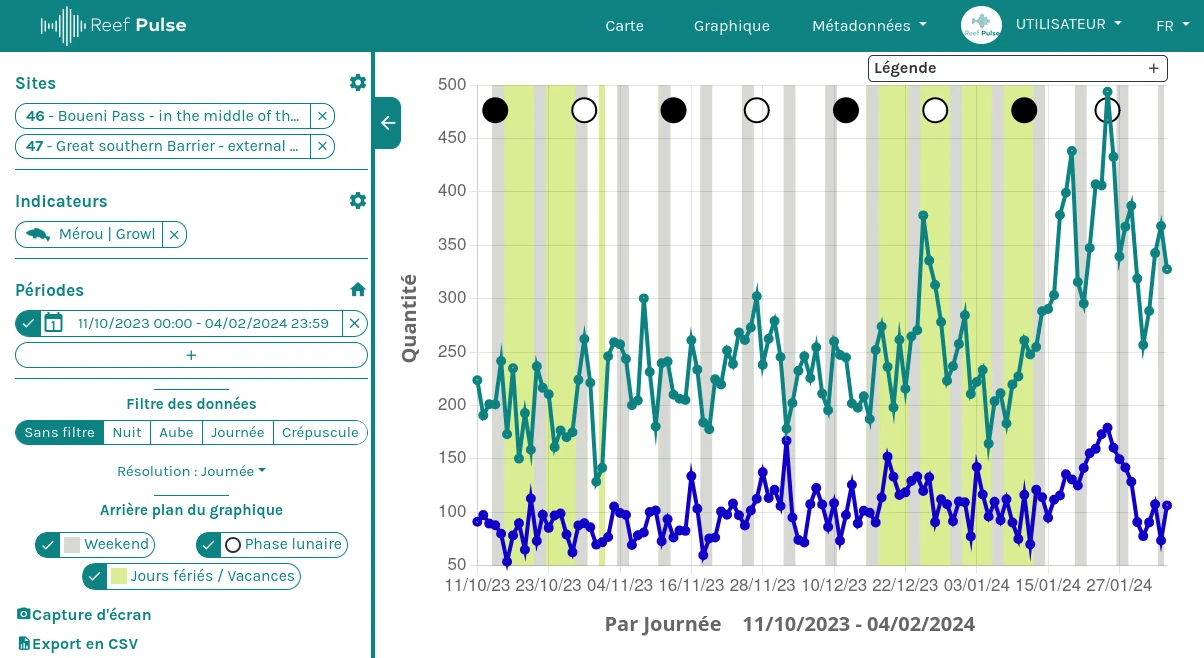
We provide our clients with a complete analysis of the recorded soundscape, as well as a private access to our internal visualisation and analysis dashboard. Beyond the analysis produced by our experts at the end of the contract, access to our dashboard allows:
- Access to both raw and transformed data (acoustic indices, per-species activity, ...)
- To continue running more analyses after the fact
- To explore the data from per-minute details to broad tendances over multiple years
- To benefit from our model updates, which lead to more precise results
Scientific expertise and thoroughness serving your project
Simon ÉLISE, CEO and cofounder of Reef Pulse, worked between 2016 and 2019 on his PhD thesis on coral reef monitoring via passive acoustics. He collaborated with many reseachers and information managers around the world. His main scientific contributions include:
- Élise S., Guilhaumon F., Mou-Tham G., Urbina-Barreto I., Vigliola L., Kulbicki M., Bruggemann J.H. (2022). Combining passive acoustics and environmental data for scaling up ecosystem monitoring: a test on coral reef fishes. Remote Sensing, https://doi.org/10.3390/rs14102394
- Élise S., Bailly A., Urbina-Barreto I., Mou-Tham G., Chiroleu F., Vigliola L., Robbins W.D., Bruggemann J.H. (2019a). An optimised passive acoustic sampling scheme to discriminate among coral reefs' ecological states. Ecological Indicators, https://doi.org/10.1016/j.ecolind.2019.105627
- Élise S., Urbina-Barreto I., Pinel R., Mahamadaly V., Bureau S., Penin L., Adjeroud M., Kulbicki M., Bruggemann J.H. (2019b). Assessing key ecosystem functions through soundscapes: a new perspective from coral reefs. Ecological Indicators, https://doi.org/10.1016/j.ecolind.2019.105623
- Darras K., [...], Élise S., [...], Wanger T. C. (2025). Worldwide soundscapes: a synthesis of passive acoustic monitoring across realms. Global Ecology and Biogeography, https://doi.org/10.1111/geb.70021
For more information, please check out his ResearchGate and ORCID profiles.
Pricing
In need of analysis for a small dataset or multiple long-term recordings? We've got you covered!
All pricings exclude VAT and shipping and are subject to change.
Standard
USD 349 / month of data / site
- One metric to choose among dozens
- One account on DashPAM, our visualisation dashboard
- Basic customer service and support
- Backup of your data during project duration
- Get our new metrics for free on your previous data even after the end of your project
- Comprehensive and synthetic scientific report including statistical analysis
- Integrations with your internal tools or open source ones with our API
- Custom AI model based on your needs
- Photogrammetry
Premium
USD 490 / month of data / site
- All our metrics
- Two accounts on DashPAM, our visualisation dashboard
- Basic customer service and support
- Backup of your data during project duration
- Get our new metrics for free on your previous data even after the end of your project
- Comprehensive and synthetic scientific report including statistical analysis
- Integrations with your internal tools or open source ones with our API
- Custom AI model based on your needs
- Photogrammetry
All-inclusive
USD 990 / month of data / site
- All our metrics
- Unlimited accounts on DashPAM, our visualisation dashboard
- Priority customer service and support
- Unlimited lifetime backup of your data on two continents
- Get our new metrics for free on your previous data even after the end of your project
- Comprehensive and synthetic scientific report including statistical analysis
- Integrations with your internal tools or open source ones with our API
- Custom AI model based on your needs
- Photogrammetry
Do you need to analyse the recordings for more sites or a longer period of time? Our annual plans below help you save money on the monthly plans.
Standard
USD 3490 / year of data / site
- One metric to choose among dozens
- One account on DashPAM, our visualisation dashboard
- Basic customer service and support
- Backup of your data during project duration
- Get our new metrics for free on your previous data even after the end of your project
- Comprehensive and synthetic scientific report including statistical analysis
- Integrations with your internal tools or open source ones with our API
- Custom AI model based on your needs
- Photogrammetry
Premium
USD 4900 / year of data / site
- All our metrics
- Two accounts on DashPAM, our visualisation dashboard
- Basic customer service and support
- Backup of your data during project duration
- Get our new metrics for free on your previous data even after the end of your project
- Comprehensive and synthetic scientific report including statistical analysis
- Integrations with your internal tools or open source ones with our API
- Custom AI model based on your needs
- Photogrammetry
All-inclusive
USD 9900 / year of data / site
- All our metrics
- Unlimited accounts on DashPAM, our visualisation dashboard
- Priority customer service and support
- Unlimited lifetime backup of your data on two continents
- Get our new metrics for free on your previous data even after the end of your project
- Comprehensive and synthetic scientific report including statistical analysis
- Integrations with your internal tools or open source ones with our API
- Custom AI model based on your needs
- Free photogrammetry worth USD 3490
Volume discount
Save up to 40 %
- 2 months offered for 10 months analysed
- 1 site offered for 3 sites analysed
- Increased discount for higher number of sites and months
Educational discount
20 %
- Are you a student, a scientist, or an NGO? We offer a 20 % discount on analysis costs!
Option A - Equipment
USD 200-20000depending on your needs
- We can analyse the recordings you already have, no matter the equipment used
- If you are starting a project with your own equipment, we help you finding the best parameters for your recording sessions
- If you don't already have recorders, hydrophones, µSD cards, stands, ... we help you find the best equipment suited to your needs
- You can buy the equipment yourself or we can buy it for you, or we can lend some of our equipment
Option B - Deployment
USD 0-10000with zero-margin on outlay costs
- We share our deployment protocol proven for 10 years
- You can deploy the equipment yourself
- If you need our assistance for deploying the equipment, our team of professional divers (IDSA level 3) is here to help! The cost depends on the mission location